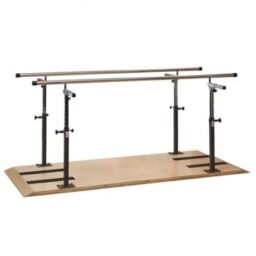
Parallel Bars
Showing all 5 results
-
-
Adjustable Folding Parallel Bars 7ft/10ft L
Item# XX33-3CLT $1,251.11 – $1,384.11Price range: $1,251.11 through $1,384.11 This product has multiple variants. The options may be chosen on the product pageWidth and height adjustable parallel bars with double stiffening rails.
-
-
Floor Mounted Parallel Bars
Item# 2104-3CLT$1,819.86Original price was: $1,819.86.$1,431.60Current price is: $1,431.60.12Â Foot Parallel Bars
-
-
Floor Mounted Parallel Bars 7ft/10ft/12ft L
Item# XX04-3CLT $1,251.89 – $1,431.60Price range: $1,251.89 through $1,431.60 This product has multiple variants. The options may be chosen on the product pageFloor mounted parallel bars intended for physical therapy. Parallel bars come in 7, 10, and 12 feet.
-
-
Height & Width Adjustable Parallel Bars
Item# XX02-3CLT $2,198.31 – $2,845.25Price range: $2,198.31 through $2,845.25 This product has multiple variants. The options may be chosen on the product pageThese height and width adjustable parallel bars can be adjusted with ergonomic control knobs located on each upright.
-
-
Wall Mounted Folding Parallel Bars
Item# 7033-3CLT$1,856.17Original price was: $1,856.17.$1,605.41Current price is: $1,605.41.This wall mounted folding parallel bars are very suitable in places where extra room is required.

What are Rehabilitation Parallel Bars and How are They Used in Clinical Settings?
Rehabilitation parallel bars are a foundational piece of equipment in physical therapy environments, used to support gait training, balance development and lower extremity rehabilitation. They provide a stable, controlled framework that allows patients to practice ambulation and weight bearing activities under clinical supervision. Commonly used in hospitals, outpatient therapy clinics and long-term care facilities, rehabilitation parallel bars are designed to accommodate a wide range of patient mobility levels, from early recovery stages to advanced functional retraining.
Unlike fixed handrails or improvised supports, rehabilitation parallel bars are engineered specifically for therapeutic use. They enable clinicians to precisely control patient positioning, monitor biomechanics and progressively adjust difficulty as strength and coordination improve.
We offer rehabilitation parallel bars that are designed with versatile mounting and adjustability features, so your therapy teams can assist a variety of patients and their rehab needs.
What Structural Features are Important for Rehabilitation Parallel Bars?
Rehabilitation parallel bars are characterized by durable construction, precise adjustability and stability under repeated use. The models referenced incorporate heavy duty square telescoping steel uprights, which provide both structural rigidity and controlled vertical adjustment. This telescoping design allows clinicians to adjust handrail height, typically from approximately 26 inches to 41 inches, accommodating different patient heights and therapeutic needs.
Handrails are typically constructed from 1-1/2″ diameter stainless steel. This material selection offers corrosion resistance, ease of cleaning and consistent tactile feedback for patients. One-piece construction eliminates joints or seams that could introduce weakness or discomfort during use.
Several models also include double stiffening rails along the base, which significantly reduce flex and lateral movement during weight bearing exercises. This added rigidity is especially important when working with patients who require substantial upper body support.
How Does Adjustability Improve Rehabilitation Parallel Bar Performance?
Adjustability is a critical feature in rehabilitation parallel bars as it directly affects patient safety, comfort and progression through therapy protocols. These systems include both width and height adjustability, and here are the benefits of each:
- Width adjustment typically ranges from approximately 16″ to 28″ or allows incremental adjustment on each side. This enables clinicians to match the bar spacing to the patient’s gait pattern and assistive needs.
- Height adjustment is facilitated by spring-loaded plungers combined with numbered height indicator strips. This allows for rapid, repeatable positioning and ensures consistency across therapy sessions.
A secondary height locking mechanism, often implemented as an additional knob, helps eliminate play on either side. This is particularly important in maintaining stability during dynamic movements such as stepping, turning or partial weight bearing exercises.
Together, these features support progressive therapy protocols by allowing incremental adjustments as the patient’s strength and balance improve.
What Mounting Configurations Are Available for Rehabilitation Parallel Bars and When Are They Used?
Rehabilitation parallel bars are available in several mounting configurations, each suited to different facility requirements and patient populations.
Floor mounted systems are designed to anchor directly into the facility’s flooring. These units offer maximum stability and are often used in clinical environments where durability and permanence are priorities. They are available in multiple lengths, commonly 7, 10, and 12 feet, allowing facilities to allocate space based on therapy needs.
Platform mounted systems integrate the parallel bars into a solid base, typically constructed from 1-1/2″ thick hardwood plywood with a durable, UV cured satin finish. These platforms often include safety tread surfaces at both ends to reduce slip risk during entry and exit. Platform mounted configurations are particularly useful in facilities where floor anchoring is not feasible or where portability within a room is required.
Foldable floor models provide additional flexibility. These systems maintain the stability of floor mounted bars while allowing the unit to be folded when not in use, making them suitable for multi-purpose therapy spaces.
What Safety Features Are Essential for Rehabilitation Parallel Bars?
Safety is a primary consideration in the design and selection of rehabilitation parallel bars. Several features contribute to patient protection and clinician confidence, including:
- End bumpers on all handrails help prevent injury in the event of forward or lateral contact.
- Non-slip safety treads on platform mounted systems reduce the risk of falls during mounting and dismounting.
- Rigid base construction, including double stiffening rails, which minimizes unwanted movement under load.
- Secure locking mechanisms, including spring-loaded plungers and secondary stabilization knobs, ensure that adjustments remain fixed during use.
- Weight capacity is another key specification. The systems described support between 350 and 400 pounds under normal physical therapy use, depending on the model and installation. This range accommodates a broad patient population while maintaining structural integrity.
It is also important to note that these systems are explicitly intended for physical therapy applications and not for gymnastic or recreational use. This distinction reflects both design intent and safety certification considerations.
How Do Dimensions and Configurations of Rehabilitation Parallel Bars Affect Facility Planning?
Facility layout and patient throughput requirements often dictate the selection of parallel bar dimensions. Available lengths typically include 7-foot, 10-foot and 12-foot configurations for various treatment room sizes.
Width and height ranges must also be considered in relation to the patient population served. Systems offering adjustable widths from approximately 16″ to 28″ and height ranges from 26″ to 41″ provide sufficient flexibility for most adult patients.
When planning installation, facilities should also account for clearance around the equipment, ensuring adequate space for clinician assistance and patient maneuvering. Platform mounted systems may require additional floor area due to the integrated base.
What Should Purchasing Professionals Evaluate When Selecting Rehabilitation Parallel Bars?
Medical equipment purchasing professionals should evaluate several criteria when selecting rehabilitation parallel bars for their facility, including:
- Structural durability, including materials such as stainless-steel handrails and steel uprights
- Adjustability range and ease of adjustment, particularly for busy rehab environments
- Mounting configuration, based on facility constraints and installation capabilities
- Safety features, including anti-slip surfaces, end bumpers, and secure locking systems
- Weight capacity and compliance with expected patient demographics
Warranty coverage is also a relevant consideration. The systems referenced include a manufacturer warranty of approximately five years, which provides assurance of lasting performance under routine clinical use.
How Do Rehabilitation Parallel Bars Support Progressive Therapy Protocols?
Rehabilitation parallel bars are integral to structured therapy progression. In early stages of rehabilitation, patients may rely heavily on the bars for weight support and balance. As therapy advances, clinicians can adjust bar height and width to encourage more natural gait patterns and reduce dependency.
The ability to make precise, incremental adjustments supports rehabilitation protocols. For example, narrowing the bar width can promote improved balance, while lowering the height may encourage greater lower extremity engagement.
Because adjustments can be made quickly using spring-loaded plungers and clearly marked height indicators, clinicians can tailor each session to the patient’s current capabilities without significant setup time.
What Role Do Parallel Bars Play in Modern Rehabilitation Facilities?
Despite advances in robotic gait systems and advanced rehabilitation technologies, parallel bars remain a core component of physical therapy environments. Their simplicity, reliability, and adaptability make them suitable for a wide range of clinical scenarios.
They serve as both a primary training tool and a transitional support system, bridging the gap between assisted mobility and independent ambulation. For purchasing professionals, selecting a system with appropriate adjustability, durability, and safety features ensures long-term utility across diverse patient populations.
Rehabilitation parallel bars are a critical investment in any facility providing mobility focused therapy. Proper equipment selection and implementation support both clinical outcomes and operational efficiency.
MSEC’s rehabilitation parallel bars are adjustable for patients of all sizes and for progressive therapy programs. They can also be floor or wall mounted, ensuring they can fit in any therapy space.