


12 Types of Surgical Scissors and Their Uses
Walk into any operating room, emergency department or clinic treatment room and you will find a dozen different scissors, each shaped for one job. The pattern names, Mayo, Metzenbaum, Lister, iris, have been stable for a century because the geometries work, but the buying decisions have changed: tungsten carbide inserts, SuperCut edges and disposable-versus-reusable math now separate one line item from another. MSEC has distributed surgical instruments to hospitals, surgery centers, EMS agencies and government buyers since 2003, and the scissors wall is one of the first places new facilities overbuy or underbuy. This guide lists the twelve types of surgical scissors that cover nearly every clinical task, what each is actually for, and what to check before you order from our surgical scissors department.
The 12 Types of Surgical Scissors
1. Operating Scissors
The general-purpose workhorse. Operating scissors come in sharp/sharp, sharp/blunt and blunt/blunt tip combinations and in straight, curved and angled blade patterns, usually between 4-1/2 and 8 inches. A facility that stocks straight sharp/blunt 5-1/2 inch operating scissors on every tray will cover most routine cutting. Our operating scissors category runs more than 70 patterns across all three tip styles, including Sims uterine lengths at 8 inches.
2. Mayo Scissors
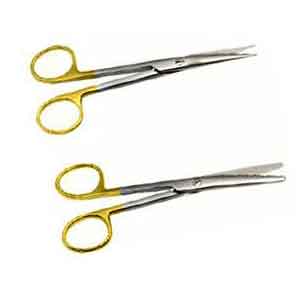
Mayo scissors are the heavy-tissue pattern: semi-blunt tips, thick blades and a short cutting stroke made for fascia, muscle and other dense structures, plus trimming suture on the back table. Straight Mayos cut near the surface; curved Mayos follow deeper tissue planes. Most ORs run both in 5-1/2 and 6-3/4 inch lengths. Compare straight and curved patterns, including tungsten carbide versions with gold rings, in our Mayo scissors category.
3. Metzenbaum Scissors
Where Mayos are the hammer, Metzenbaums are the scalpel of the scissors tray: long shanks, short fine blades and a light feel built for delicate tissue dissection rather than cutting strength. They should never be used on suture, because that is how a facility dulls its most expensive scissors fastest. Metzenbaum, Nelson and Lahey patterns from 5-1/2 inches to 12 inches, in standard and tungsten carbide grades, live in our dissecting scissors category.
4. Iris Scissors
Originally an ophthalmic pattern, iris scissors are now everywhere fine, precise cuts are needed: dermatology, plastics, podiatry, suture removal in tight spots. Small ring handles, needle-point tips and blades usually 3-1/2 to 4-1/2 inches. Straight for surface work, curved for contour. Buy them in surgical stainless or carbide-edged grades and keep them away from dressings. See straight, curved and DeWecker patterns in the iris scissors category.
5. Eye Scissors
The broader ophthalmic family beyond iris patterns: strabismus scissors, Westcott-style spring scissors and enucleation patterns with blades ground for work around the eye. These are specialty instruments a general clinic rarely needs, but an ophthalmology or oculoplastics practice should buy them as a matched set rather than piecemeal so the feel is consistent across the tray. Our eye scissors category covers about 30 patterns.
6. Stitch and Suture Removal Scissors
Stitch scissors carry a small hook or notch on one blade that slides under a suture and lifts it before the cut, so the stitch comes out without digging at the skin. Littauer and Spencer are the standard patterns, usually 3-1/2 to 5-1/2 inches. Every exam room, urgent care and med-surg floor should have them; using iris scissors for suture removal is the most common substitution and the least safe one. Stock them from the stitch scissors category.
7. Bandage Scissors
The Lister bandage scissor is the pattern everyone recognizes: an angled shank and a flat, blunt lower lip that rides against the skin while the blades cut dressings, gauze and tape away from the patient. Common sizes run 5-1/2 to 8 inches, including one-large-ring versions that give a gloved hand more pull. Every crash cart, wound cart and first aid station needs a pair. Our bandage scissors category stocks Lister and Knowles patterns in the full size run.
8. Utility and Trauma Shears
Trauma shears are the EMS evolution of the bandage scissor: serrated blades, a blunt safety tip and coated handles, strong enough to cut through a leather belt, denim or a boot lace in one pass. They are also the pattern facilities buy in bulk because they walk away. Coated-handle utility shears in 5-1/2 and 7-1/2 inch sizes are in our utility shears category.
9. Nasal and Turbinate Scissors
ENT work needs reach through a narrow passage, so nasal scissors carry long shanks, short angled blades and patterns like the Seiler turbinate scissor. An ENT practice should match these to its speculum and forceps sets rather than buying generic long scissors. The nasal scissors category carries a dozen patterns including angled Seiler turbinate designs.
10. Episiotomy Scissors
A labor and delivery pattern: angled blades with one blunt, guarded tip, built for a controlled cut with maximum protection on the tissue side. Braun-Stadler is the common design, usually 5-1/2 to 8-1/2 inches. These belong on every delivery tray even where episiotomy rates are low, because when one is needed there is no substitute. Find them in the episiotomy scissors category, and see our gynecological instruments guide below for the rest of the OB tray.
11. Cartilage Scissors
Heavy, often serrated blades made for nasal and ear cartilage in rhinoplasty, otoplasty and reconstructive work. Fomon and Cottle are the recognizable patterns. A general facility will not need them; a plastics or ENT surgery center should buy one quality pair per room rather than three economy pairs. Our cartilage scissors category covers the standard patterns.
12. SuperCut Operating Scissors
SuperCut is an edge grind, not a shape: one blade carries a razor edge and the other a micro-serrated edge, so the scissor slices rather than crushes and tissue does not slip out of the bite. SuperCut versions of Mayo, Metzenbaum and operating patterns are identified by black ring handles and cost more, which is worth it for dense or slippery tissue. Compare them in the SuperCut operating scissors category.
Matching Scissors to Procedures and Tissues
The fastest way to sanity-check a tray list is to walk the procedures it serves and name the tissues each one meets. Soft tissue dissection calls for Metzenbaums, dense fascia and suture call for Mayos, skin and fine structures call for iris patterns, and dressings and bandages always get their own dedicated pair so the surgical edges stay surgical. Facilities that map scissors to procedures this way almost always find one redundant pattern they can drop and one missing pattern, usually stitch scissors, that staff have been working around. The same walk-through catches sizing problems: pediatric procedures need shorter instruments, deep-cavity procedures need longer shanks, and bariatric and orthopedic tissues justify the heavier SuperCut grinds.
How to Choose: Three Decisions That Matter More Than the Pattern
First, steel grade. German-forged surgical stainless holds an edge through hundreds of autoclave cycles; floor-grade economy instruments are fine for dressing carts and training but should never be the OR standard. Second, tungsten carbide. TC inserts (gold-ring handles) roughly triple edge life on the patterns you use daily, and on Mayos and Metzenbaums the per-cycle math nearly always favors them. Third, sharp inventory discipline. Facilities that tag scissors by tray and send them out on a scheduled sharpening rotation spend less per year than facilities that replace dull pairs, and the surgeons notice the difference. If you are specifying trays for a new facility, our team quotes complete scissor sets by specialty, and our needle drivers guide and surgical retractors guide cover the instruments that sit beside the scissors on every tray. MSEC holds GSA contract V797P-2194D for government and VA buyers.
Frequently Asked Questions
What is the difference between Mayo and Metzenbaum scissors?
Mayo scissors have short, heavy blades for cutting dense tissue like fascia and for trimming suture. Metzenbaum scissors have long shanks and short, fine blades for delicate tissue dissection only. Using Metzenbaums on suture dulls them quickly, which is why trays carry both.
What do sharp/sharp, sharp/blunt and blunt/blunt mean?
The terms describe the two blade tips of operating scissors. Sharp/sharp gives maximum point precision, blunt/blunt protects tissue when cutting near structures, and sharp/blunt is the general-purpose compromise most facilities standardize on.
Are tungsten carbide scissors worth the extra cost?
For scissors used daily, usually yes. Tungsten carbide cutting inserts hold an edge roughly three times longer than standard stainless, so the cost per sterilization cycle is often lower even though the purchase price is higher. Gold ring handles are the industry marker for TC instruments.
Which scissors should every exam room have?
At minimum: one pair of Lister bandage scissors for dressings, one pair of Littauer stitch scissors for suture removal, and one pair of straight sharp/blunt operating scissors for general cutting. High-traffic rooms add utility shears because they handle the abuse that would ruin surgical-grade instruments.
How should surgical scissors be sharpened and maintained?
Send instruments to a qualified sharpening service on a scheduled rotation rather than waiting for complaints, inspect blade edges and tip alignment at each tray assembly, and keep delicate patterns like iris and Metzenbaum scissors off dressings and suture. Proper rotation costs less per year than replacing dull instruments.
Related Pages
- Surgical Scissors department – every category in this guide in one place.
- Bandage Scissors and Trauma Shears buying guide – a deeper look at the two patterns every facility buys in volume.
- Bone Saws buying guide – Gigli, Satterlee and amputation saw patterns from the same orthopedic instrument wall.
- Needle Drivers and Needle Holders guide – choosing the closure instruments that pair with every scissors tray.
- Ask the Pros – free product guidance from the MSEC team, or call 877-706-4480.
No related posts.