
Wall Mounted Desks & Workstations
13 wall mounted desks and workstations: charting surfaces that fold out of the corridor’s way.
Home » Hospital & Durable Medical Equipment » Computer Carts & Desks » Wall Mounted Desks & Workstations
The Desk That Lives On The Wall
Clinical charting happens in hallways and rooms with no floor to give: wall mounted desks fold work surfaces and computer stations flat against the wall between uses. Thirteen builds split into the desk and computer-station lines below, with fold depth and capacity per model.
Shop The Wall Mounted Desks & Workstations Range by Type
Each line opens its models with specifications per product.
Shop Wall Mounted Desks & Workstations
Everything MSEC carries in Wall Mounted Desks & Workstations, shown in full. Specifications are supplied by the manufacturer. For current pricing, lead time or a quote on a purchase order, call toll free 877-706-4480.
-
Quick ViewSelect options -
Quick ViewSelect optionsHeavy-Gauge Steel Laptop Wall Desk
Item# X955192OMI $537.86 – $722.43Price range: $537.86 through $722.43 -
Quick ViewSelect options -
Quick ViewSelect optionsHeavy-Gauge Steel Deluxe Wall Desk
Item# X65192OMI $537.86 – $578.29Price range: $537.86 through $578.29 -
Quick ViewSelect optionsHeavy-Gauge Steel Elite Wall Desk
Item# X35192OMI $622.43 – $759.29Price range: $622.43 through $759.29 -
Quick ViewSelect optionsHeavy-Gauge Steel Slimline Wall Desk
Item# XX65192OMI $523.00 – $564.29Price range: $523.00 through $564.29
What Are Wall Mounted Desks and Workstations?
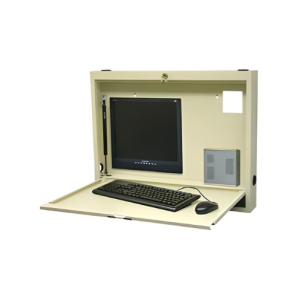
Wall mounted desks and workstations are computing and writing stations attached to walls rather than standing on the floor or rolling on casters. Many fold flat against the wall when not in use and open to reveal a work surface, with a computer, monitor and keyboard housed inside a cabinet. Hospitals mount them at patient room entrances, in corridors, in medication rooms and in exam rooms so clinicians can document near the patient without bringing a cart into the room or leaving equipment in the hallway. Long term care facilities, clinics and behavioral health units also use them. Each product listing gives specifications per model, including open and closed dimensions, interior space for hardware, locking features and mounting requirements. Choosing the right model depends on the hardware it will hold, the wall construction and the space available when the station is folded and opened.
Why Choose Wall Mounted Stations Instead of Carts?
Mobile workstations are useful, but they take up space in corridors and patient rooms and must be cleaned as they move between patients. Wall mounted stations stay in place, so corridors remain clear for beds, wheelchairs and equipment, which can help facilities meet egress requirements. Because they do not travel from room to room, they are less likely to carry contamination between patients. Staff always know where the station is and do not have to search for an available cart. Wall stations also eliminate the need for battery systems, since they can be connected to building power and networks. The tradeoff is that the station cannot move to the patient’s bedside, so documentation happens at the door or a short distance from the bed. Many facilities combine wall stations at room entrances with mobile carts for bedside tasks such as medication administration.
Where Should Wall Stations Be Installed?
Placement depends on the workflow. Stations at patient room entrances let staff document immediately after leaving the room or while observing the patient. Stations inside rooms allow documentation closer to the patient but take wall space in the room. Corridor stations between rooms can serve two or more rooms. Medication room and exam room stations support specific tasks. When choosing locations, consider where documentation naturally occurs, the wall space available, electrical and network access and corridor clearance when the station is open. Clear floor space in front of the station is needed for the user. Mapping workflows on a floor plan helps determine the best locations.
What Hardware Can Wall Stations Hold?
Wall stations are designed to house computers, monitors, keyboards, mice, scanners and sometimes printers. Interior dimensions must accommodate the facility’s hardware, including thin clients, all in one computers or compact desktops. Monitor mounts, keyboard trays and cable management keep equipment organized. Ventilation prevents computers from overheating inside closed cabinets. Locking doors protect equipment and patient information when the station is closed. Involving IT in selecting wall stations ensures hardware fits and ventilation is adequate. Listings give interior dimensions and features.
How Do Folding Designs Work?
Folding wall stations have a front panel that folds down or swings open to form the work surface, revealing the keyboard and monitor inside. When closed, the station projects only a few inches from the wall, keeping corridors clear. Gas springs or counterbalance mechanisms help the panel open and close smoothly and stay in position. Some designs lock automatically when closed. The work surface should be sturdy enough to support writing and typing. Folding mechanisms should be durable, since stations may be opened and closed many times per shift. Listings describe folding mechanisms and closed depth.
Why Does Closed Depth Matter?
Building codes and facility policies often limit how far objects can project into corridors to maintain clear egress paths. A wall station that projects too far when closed may not comply. Closed depth also affects whether people and equipment can pass without bumping the station. Facilities should confirm corridor width requirements and choose stations that meet them. Listings give closed and open depths.
What Mounting Requirements Apply?
Wall stations must be mounted securely to walls that can support their weight plus the forces applied when users lean on the work surface. Wall construction should be evaluated before installation, and blocking or reinforcement may be needed in some walls. Electrical and network connections must be available at the station location. Facilities engineering should review mounting requirements. Listings provide weight, dimensions and mounting specifications.
How Do Wall Stations Support Privacy and Security?
Wall stations in corridors are visible to passersby, so screen privacy matters. Privacy filters, screen angles and automatic logoff policies help protect patient information. Locking doors secure hardware and prevent unauthorized access when closed. Facilities should consider privacy requirements when choosing station locations and features.
How Are Wall Stations Cleaned?
Wall stations should be cleaned regularly with approved disinfectants, including the work surface, keyboard, mouse and door handles. Washable keyboards simplify cleaning. Smooth surfaces without crevices are easier to clean. Because stations stay in place, cleaning schedules can be built into routine unit cleaning.
How Are Wall Stations Maintained?
Maintenance includes checking folding mechanisms and gas springs, inspecting locks, verifying mounting security and checking ventilation. Hardware inside the station is maintained by IT. Replacement parts should match the station model.
What About Ergonomics?
Wall stations are mounted at a fixed height, which may not suit every user. Some models offer adjustable keyboard trays or monitor mounts to improve ergonomics. Mounting height should be chosen to suit the typical user, often for standing use. Facilities can consult ergonomic guidance when setting mounting heights.
Where Are Wall Stations Used?
Wall stations are used in hospital patient room entrances and corridors, medication rooms, exam rooms, long term care resident corridors, clinics and behavioral health units where carts are not appropriate. They suit any setting that needs documentation near patients without mobile equipment.
How Do Facilities Order Wall Stations?
Orders start with workflow mapping and floor plans to identify station locations, followed by confirming hardware, wall construction and corridor clearance. MSEC quotes unit and facility orders, accepts purchase orders from hospitals, long term care facilities, clinics and government buyers, and offers GSA contract pricing for federal and VA facilities. The order desk at 877-706-4480 can help match stations to hardware and locations before anything ships.
How Do Wall Stations Affect Workflow Efficiency?
Documentation is one of the most time consuming parts of clinical work, and where it happens affects efficiency. When staff must walk back to a central nurse station after every patient interaction, time is lost in travel and details may be forgotten. Wall stations at room entrances let staff document immediately, reducing travel and improving accuracy. They also keep staff closer to patients, which supports observation and quick response. Units that add wall stations often find that staff spend less time walking and more time near patients. The stations also reduce competition for computers at the nurse station. To maximize efficiency, station locations should match where staff naturally pause after patient care, and the stations should open quickly and log in easily. Pairing wall stations with single sign on or badge access can speed up logging in, further reducing the time spent on documentation.
How Do Wall Stations Work in Behavioral Health Settings?
Behavioral health units often limit mobile equipment because carts and loose items can pose safety risks for patients. Wall mounted stations provide a way for staff to document without bringing carts onto the unit. In these settings, stations should be designed to reduce ligature points, resist tampering and lock securely so patients cannot access equipment or information. Rounded edges and concealed hardware add safety. Stations may be placed in staff areas or at secure locations within the unit. Facilities should involve their safety team in selecting stations for behavioral health spaces to confirm that the design meets their requirements. The order desk can provide product details, but approval for behavioral health use should come from the facility’s safety and clinical leadership. Choosing the right station allows behavioral health staff to document efficiently while maintaining the safe environment these units require.
Frequently Asked Questions
What is a wall mounted workstation?
It is a computing station attached to a wall, often folding flat when closed, housing a computer, monitor and keyboard for documentation.
Why use wall stations instead of carts?
Wall stations keep corridors clear, reduce cross contamination and are always in the same place, though they cannot move to the bedside.
Where should wall stations be installed?
Common locations include patient room entrances, corridors between rooms, medication rooms and exam rooms.
Do wall stations comply with corridor clearance requirements?
Check closed depth against your corridor requirements. Many folding designs project only a few inches when closed.
What should be confirmed before installation?
Confirm wall construction, electrical and network access, hardware fit, ventilation and corridor clearance.
Can MSEC quote wall mounted workstations?
Yes. MSEC accepts purchase orders and offers GSA contract pricing for federal and VA facilities. Call 877-706-4480 or 713-706-4480.
Related Hospital Equipment Categories
More lines from Computer Carts & Desks and the wider Hospital department.
Laptop & Computer Stands
6 products
Talk to a Medical Equipment Specialist
Toll free 877-706-4480 | Local 713-706-4480 | inquiry@msecompany.net

