

Medical Cart Accessories
The 188-item accessory layer for the cart fleet: tray dividers, holders, rails, bins, shelves, cardiac boards and the packages that turn a bare cart into a working station.
Home » Hospital & Durable Medical Equipment » Medical Carts » Medical Cart Accessories
The Interior Is Half The Cart
A cart ships as potential; the accessory layer makes it a workstation. Dividers organize dosing trays, rails and holders put gloves, sharps and wipes at reach, cardiac boards ride crash carts, and bins and cassettes make exchange restocking possible. The lines below sort the layer by what it does, so a cart manager can outfit a new cart or standardize an old fleet without guessing at part fit.
Shop The Medical Cart Accessories Range by Type
Each line opens its models with specifications per product.
Shop Medical Cart Accessories
Everything MSEC carries in Medical Cart Accessories, shown in full. Specifications are supplied by the manufacturer. For current pricing, lead time or a quote on a purchase order, call toll free 877-706-4480.
-
Quick ViewSelect options -
Quick ViewSelect options
What Are Medical Cart Accessories?
Medical cart accessories are the add on components that turn a cart chassis into a working clinical station. They include sharps container brackets, glove box holders, IV poles and panels, cardiac boards and brackets, side shelves, pull out writing surfaces, rails and bars, racks and hooks, bins and cassettes, drawer organizers and tray dividers, containers and baskets, electrical outlet strips and packaged accessory sets. Each type has its own page with products listed per model. Most carts arrive with a basic configuration, and accessories adapt them to the specific workflow of a unit, whether that is a medication pass, a code response, an anesthesia case or a wound care round. Choosing the right accessories makes carts faster to use, keeps work surfaces clear and keeps essential items within reach exactly where staff need them.
Why Does Accessory Compatibility Matter?
Accessories mount to a cart’s rails, side panels, brackets or drawers, and those mounting systems differ by cart brand and model. An accessory designed for one rail profile may not fit another, even if the carts look similar. Ordering by appearance or general size is the most common cause of accessories that arrive as a near fit and cannot be installed securely. Each accessory listing in this family names the carts or mounting systems it fits. The reliable approach is to order accessories by the cart’s brand and model number. For new carts, ordering accessories at the same time as the cart ensures compatibility and lets everything be mounted before the cart reaches the floor. For carts already in service, checking the model number on the cart’s label before ordering avoids returns and installation problems.
Which Accessories Do Medication Carts Typically Need?
Medication carts benefit from accessories that support the med pass. A sharps container bracket keeps needle disposal within reach. A glove box holder keeps gloves accessible. A cup dispenser holds medication cups, and a waste bin collects packaging. A locking narcotics box adds secure storage for controlled substances where the cart does not include one. Bins, cassettes and dividers organize each patient’s medications within the drawers. A pull out shelf or writing surface adds working space for documentation. Electrical outlet strips power laptops, scanners and printers on carts used for electronic documentation. Facilities often define a standard accessory set for every medication cart so staff find the same tools on every cart. That standard can then be ordered with each new cart and used to retrofit older carts as needed.
Which Accessories Do Crash Carts Need?
Crash carts carry equipment beyond their drawers, and accessories hold it securely. A cardiac board mounted on a bracket on the back of the cart provides a firm surface under the patient during compressions. An oxygen tank holder carries a cylinder. A defibrillator shelf supports the defibrillator on top of the cart. An IV pole lets fluids be hung during the response. Sharps container and glove holders keep essentials at hand. Breakaway locks and numbered seals secure the cart between checks. Many facilities specify a standard accessory set for all crash carts so responders know exactly what to expect. Cart accessory packages bundle common accessory sets, and the cardiac boards and brackets page lists boards and mounts by compatible cart model.
How Do Bins, Cassettes and Dividers Organize Drawers?
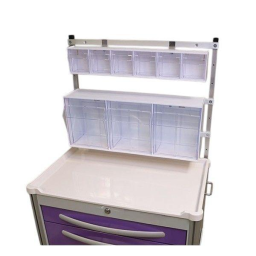
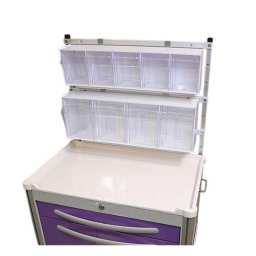
Inside the drawers, organization determines how quickly staff find what they need. Bins and cassettes divide a drawer into compartments, often one per patient on medication carts, and can be removed for restocking or exchanged with pharmacy. Tray dividers create fixed sections that keep a drawer layout consistent across every cart in a fleet. Drawer organizers handle small items such as syringes, vials and swabs. Fit depends on the drawer’s interior dimensions, so measuring the drawer or ordering by cart model ensures the organizers fit properly. Consistent organizers across a fleet support standardized drawer maps, which help float staff and make restocking faster. Each organizer listing gives dimensions and compatible drawers.
What Do Rails, Racks and Hooks Add?
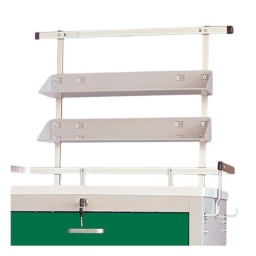
Rails and bars are the foundation that many other accessories attach to. Adding a rail to the side of a cart creates mounting points for holders, baskets and hooks. Push bars give a better grip for moving loaded carts. Racks hold charts, binders and documents, and hooks hang bags, cables and tubing. These accessories keep items off the cart top and out of drawers where they would take up useful space. Rails mount to specific points on the cart chassis, so compatibility is by model. Weight ratings matter, since a loaded rack or hook absorbs every bump during transport. Listings give mounting details and capacity for each item.
When Are Shelves and Electrical Outlets Useful?
Pull out and side shelves add working surface without making the cart permanently larger. A pull out shelf can serve as a writing surface, a laptop platform or a staging area for supplies and slides away when not needed. Side shelves hold equipment that does not fit in drawers. Electrical outlet strips mounted to the cart power devices such as laptops, scanners, printers and diagnostic equipment, which is essential for computer and EKG carts and useful on medication carts that support electronic documentation. Outlet strips should be mounted securely and cords managed along the chassis. Facility electrical policies govern what may be powered at the bedside. Listings give shelf dimensions, load ratings and outlet specifications.
What Are Cart Accessory Packages?
Accessory packages bundle sets of accessories commonly used together, such as a medication cart starter set or a crash cart board and holder kit. They simplify ordering, since one line item provides a complete set with components designed to fit the same mounting system. Packages are useful when outfitting new carts or standardizing a fleet. Before ordering, compare the package’s listed contents with the facility’s accessory standard. If a package matches, it is the most efficient option. If it differs by a component or two, individual accessories from this family can complete the set. The order desk can compare package and individual pricing.
How Are Cart Accessories Maintained?
Accessories should be cleaned with the cart using approved disinfectants, since they are touched constantly. Mounting hardware should be checked periodically to make sure holders, rails and shelves remain secure, especially on carts that move frequently. Damaged or cracked accessories should be replaced, since broken holders can drop items and rough edges can catch gloves. Seals and breakaway locks on crash carts are consumables that must be restocked. Keeping a small stock of common accessories for the facility’s cart models allows quick replacement. Ordering by cart model ensures replacements fit.
How Do Facilities Order Cart Accessories?
Facilities typically define an accessory standard for each cart type, then order accessories with new carts or by cart model for existing fleets. MSEC quotes accessory orders of any size, accepts purchase orders from hospitals, clinics, long term care facilities and government buyers, and offers GSA contract pricing for federal and VA facilities. The order desk at 877-706-4480 can confirm compatibility from cart model numbers before anything ships.
How Do Accessories Support Standardized Fleets?
When a facility standardizes its carts, accessories are part of the standard. A medication cart standard might specify the sharps container on the right rail, the glove holder on the left, a cup dispenser at the front corner and a specific bin layout in each drawer. A crash cart standard might specify the board on the back, the oxygen holder on the left side and the defibrillator shelf on top. When every cart follows the same accessory layout, staff can work from any cart without searching, which matters for float staff and during emergencies. Documenting the accessory standard alongside the drawer map, then ordering accessories in matching sets for every cart, keeps the fleet consistent. When accessories wear out or carts are added, the standard guides replacement so new items match the existing layout. This approach also simplifies ordering, since the same accessory part numbers repeat across the fleet and can be stocked as spares.
Frequently Asked Questions
What medical cart accessories does MSEC carry?
MSEC carries sharps and glove holders, IV poles, cardiac boards, shelves, rails, racks, hooks, bins, cassettes, organizers, dividers, baskets, outlet strips and accessory packages.
How do I know an accessory fits my cart?
Order by your cart’s brand and model number. Each listing names the carts or mounting systems the accessory fits.
What accessories does a crash cart need?
Common crash cart accessories include a cardiac board and bracket, oxygen tank holder, defibrillator shelf, IV pole, sharps and glove holders and breakaway seals.
Can I add accessories to an older cart?
Yes, as long as the accessory is compatible with the cart’s mounting system. Check the cart’s model number and match it to the accessory listing.
What is a cart accessory package?
A package bundles a set of commonly used accessories designed to fit the same mounting system, simplifying ordering when outfitting carts.
Can MSEC confirm accessory compatibility?
Yes. Send your cart model numbers to the order desk at 877-706-4480 or 713-706-4480 and they will confirm fit before shipping.
Related Hospital Equipment Categories
More lines from Medical Carts and the wider Hospital department.
Emergency Crash Carts
57 products
Anesthesia Carts
37 products
Medication Carts
36 products
Isolation Carts
27 products
Treatment Carts
22 products
Hospital Specialty Carts
13 products
Quick Ship Medical Carts
12 products
Hospital Storage Carts
8 products
Talk to a Medical Equipment Specialist
Toll free 877-706-4480 | Local 713-706-4480 | inquiry@msecompany.net


