
web analytics

Overbed Tables

9 overbed tables in deluxe and standard lines: the bedside surface every occupied bed ends up needing.

The Table That Comes To The Patient

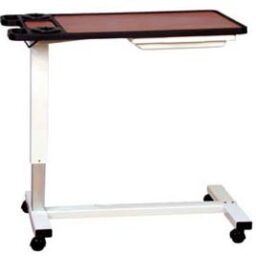
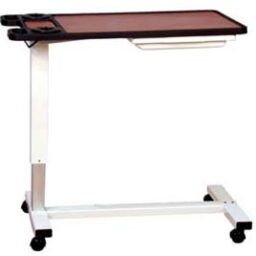
Meals, tablets, paperwork and care items all need a surface at the bed, and the overbed table swings it over the patient on demand. Nine builds split into deluxe and standard lines, differing in tops, adjustment and finish, with the bariatric-width builds living in their own family.

Shop The Overbed Tables Range by Type

Each line opens its models with specifications per product.

Shop Overbed Tables

Everything MSEC carries in Overbed Tables, shown in full. Specifications are supplied by the manufacturer. For current pricing, lead time or a quote on a purchase order, call toll free 877-706-4480.

What Does an Overbed Table Actually Do in a Patient Room?

An overbed table is the patient’s personal work surface. It carries meals three times a day, holds the water pitcher, phone, glasses and reading material between meals, and becomes the surface for puzzles, cards, letter writing and telehealth visits on a tablet. Staff use it too: a place to set a meal tray down, stage a basin during bathing, or rest supplies during a bedside task. Because it is the one piece of furniture the patient controls, it shapes how independent a stay feels. A table that rolls into position easily and sets to the right height lets a patient eat and occupy themselves without calling for help, while a table that is too short, too wobbly or too hard to adjust turns every meal into a staff task. That is why facilities that think carefully about patient experience treat the overbed table as clinical furniture rather than an afterthought, and why the range on this page spans standard, deluxe and bariatric builds instead of one generic model.

How Do Standard, Deluxe and Bariatric Tables Differ?

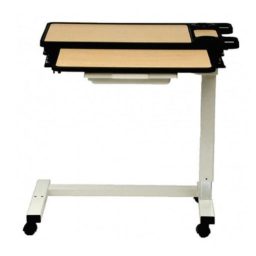
The three lines split by what the table needs to do beyond holding a tray. Standard tables cover the core job: a laminate top on a single column, height adjustment, and a rolling base that slides under the bed. They are the volume purchase for facilities furnishing whole floors. Deluxe tables add features that matter during long stays, such as tilting reading tops, split tops with a fixed section that stays level while the other half tilts, vanity mirrors and storage compartments, and upgraded finishes that make a room feel less institutional. Bariatric tables widen the top, strengthen the column and spread the base so the table fits wider bed frames and stays stable under heavier use. Most facilities run a mix: standard tables as the default, deluxe tables in long term care and rehabilitation rooms where patients spend weeks, and bariatric tables assigned to the rooms that carry bariatric beds. Each line has its own page with the full product set and per model specifications.

Why Does the Base Shape Matter So Much?

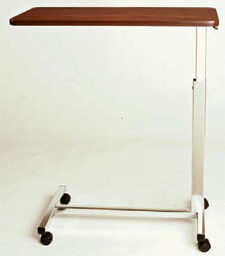
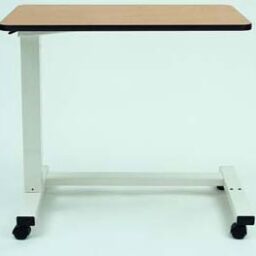
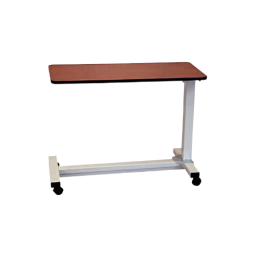
The base decides whether the table actually reaches the patient. Overbed tables use H, U and C shaped bases, and the job of each is to slide under the bed frame so the top can cantilever over the patient’s lap. If the base legs collide with the bed’s frame, wheels or lift mechanism, the top stops short and the patient leans forward to eat, which is uncomfortable and works against good positioning. Low beds and beds with full length frames make this worse, since there is less clearance beneath them. The check that prevents returns is simple: compare the listed base height and inside base width against the clearance under the beds the facility actually runs. U and C bases also wrap around recliners and wheelchairs, so tables that serve patients sitting out of bed need that geometry. Base footprint affects stability as well, since a wider stance resists tipping when a patient pushes down on the top, which is a common habit when shifting position.

What Height Range Should a Facility Look For?

Height range determines who the table serves. The top needs to sit comfortably over a patient lying in a raised bed, sitting upright in bed, sitting in a recliner, or sitting in a wheelchair, and those positions span a wide range. A table that cannot go low enough fails the wheelchair user; one that cannot go high enough fails the patient in a bed raised to a caregiving height. The listed minimum and maximum heights per model answer the question directly, and they should be compared against the beds, chairs and wheelchairs in the rooms the table will serve. The adjustment mechanism matters as much as the range. Counterbalanced and spring assisted lifts let a patient raise the top with a light touch and lower it with a release lever, which supports independence. Crank and knob mechanisms are sturdy and inexpensive but usually need a caregiver. If patients are expected to adjust their own tables, specify a mechanism that matches their strength and dexterity.

Which Top Features Are Worth Paying For?

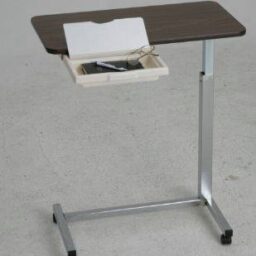
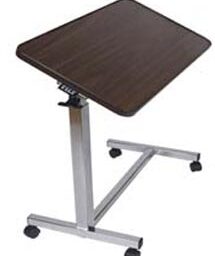
The top is where patients interact with the table, so its details add up over a stay. Raised edges or molded spill rims keep liquids from running into the bed. Seamless laminate and molded tops clean faster and leave fewer crevices for residue. Tilting tops turn the table into a reading stand or a tablet holder, which matters in long stays. Split tops combine a fixed level section for drinks with a tilting section for reading, so a patient never has to choose. Vanity models add a mirror and a small storage compartment under a hinged lid, giving patients a place for personal grooming items that otherwise clutter the top. Size matters too: a larger top holds a full meal tray with room for a drink and utensils, while a compact top suits tight rooms and patients who mostly need a place for small items. Every listing on the line pages states top dimensions and the features each model includes.

How Are Overbed Tables Cleaned and Kept in Service?

An overbed table touches food, hands and personal items all day, so it sits on every room cleaning checklist. Tops should be wiped with the facility’s approved disinfectant between patients and routinely during a stay, and the column and base need attention at turnover since they collect splashes and dust. Laminate and molded tops tolerate hospital cleaning chemistry well, which is a large part of why they dominate healthcare models. Over years of service the wear points are predictable: casters that stop rolling smoothly, lift mechanisms that drift or stick, and edge banding that loosens on laminate tops. Facilities that inspect tables at room turnover catch these early, and replacement casters and parts keep a table in service rather than retiring it. Locking casters deserve a periodic check, since a table that rolls away when a patient leans on it creates an obvious problem. Tables that no longer hold height or roll true are usually cheaper to replace than to keep repairing.

How Do Facilities Buy Overbed Tables at Volume?

Overbed tables are almost always bought by the room count. A facility furnishing a new wing or refreshing a floor typically picks one standard model for general rooms, a deluxe model for long stay rooms, and a bariatric model for the rooms that carry bariatric beds, then orders each by quantity. Standardizing models across a building simplifies replacement parts, keeps rooms consistent for staff, and makes future orders a repeat rather than a new research project. Before a volume order, confirm base clearance against every bed model in service, since a mixed bed fleet sometimes needs two table models. Color and finish choices should match the room scheme. MSEC quotes floor and building orders, accepts purchase orders from hospitals, long term care facilities and clinics, and offers GSA contract pricing for federal and VA facilities. The order desk at 877-706-4480 can match tables to a bed list before anything ships.

Frequently Asked Questions

An overbed table gives a patient a personal work surface over the bed or chair. It holds meal trays, drinks, phones, reading material and personal items, and supports activities like writing, puzzles and tablet use. Staff also use it to stage supplies during bedside tasks. A well chosen table lets patients eat and occupy themselves without needing help for every adjustment.

Not always. The base has to slide under the bed frame for the top to reach the patient, and low beds or beds with full length frames leave less clearance. Compare the table’s listed base height and inside width against the clearance under the beds you run. Facilities with mixed bed fleets sometimes need two table models to cover every room properly.

A standard table covers the core job with a laminate top, height adjustment and a rolling base. Deluxe tables add features for longer stays, such as tilting or split tops, vanity mirrors, storage compartments and upgraded finishes. Many facilities use standard tables as the default and assign deluxe tables to long term care and rehabilitation rooms where patients stay for weeks.

Rooms that carry bariatric beds generally need bariatric overbed tables. Wider bed frames call for wider bases to clear them, and bariatric tables add larger tops and sturdier columns for stability under heavier use. Matching the table to the bed avoids a top that stops short of the patient. Check the listed base dimensions against the bariatric bed model in the room.

That depends on the lift mechanism. Counterbalanced and spring assisted tables raise with a light touch and lower with a release lever, which many patients can manage independently. Crank and knob mechanisms are durable and economical but usually need a caregiver to adjust. If patient independence is a goal for the unit, specify a mechanism that matches the strength and dexterity of the patients it will serve.

Yes. MSEC quotes room count orders for hospitals, long term care facilities, rehabilitation centers and clinics, accepts purchase orders, and offers GSA contract pricing for federal and VA buyers. The order desk can confirm base clearance against your bed models before an order ships. Call toll free 877-706-4480 or locally 713-706-4480 for a quote.

Related Hospital Equipment Categories

More lines from Medical Room Furnishings and the wider Hospital department.

Talk to a Medical Equipment Specialist

Toll free 877-706-4480  |  Local 713-706-4480  |  inquiry@msecompany.net

Scroll to Top