
Training Stairs
Rail supported practice staircases and a curb and ramp training set for outpatient clinics, hospital rehab departments and skilled nursing facilities, with the clearance, capacity and freight details to confirm first.
Home › Rehabilitation Equipment › Physical Therapy Equipment › Training Stairs
Training Stairs for Rehabilitation Gyms and Therapy Departments
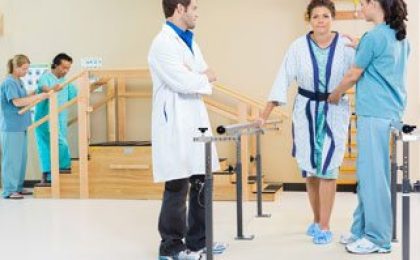
Training stairs are rail supported practice staircases used in therapy gyms so a clinician can supervise stepping work indoors, with a handrail and a therapist within reach. MSEC stocks fixed and adjustable staircases in one sided and convertible rail configurations, in 30in and 36in widths, plus a curb and ramp set for surface transitions. Buyers are outpatient clinics, hospital rehab departments, skilled nursing facilities and school based therapy programs inside the Physical Therapy Equipment line.
Shop Training Stairs
Everything MSEC carries in Training Stairs, shown in full. Specifications are supplied by the manufacturer. For current pricing, lead time or a quote on a purchase order, call toll free 877-706-4480.
-
 Quick ViewSelect options
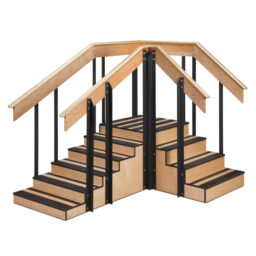
Convertible Rail Support System Staircase
Item# X0805-4CLT $2,214.29 – $2,285.71Price range: $2,214.29 through $2,285.71 -
 Quick ViewSelect options
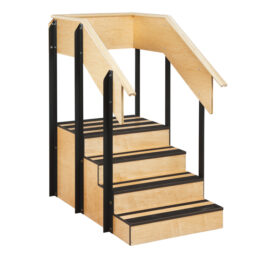
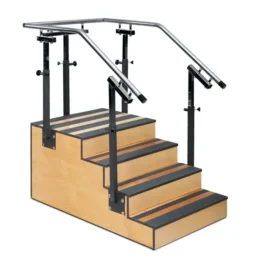
One-Sided Rail Support Staircase System 30in/36in W
Item# X1055-4CLT $1,012.86 – $1,128.57Price range: $1,012.86 through $1,128.57 -
 Quick ViewSelect options
 -
 Quick ViewSelect options
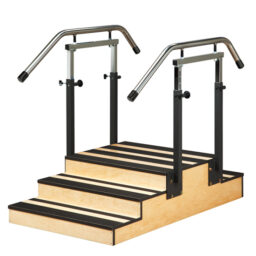
Adjustable One-Sided Staircase 30in/36in W
Item# X1056-4CLT $1,652.79 – $1,805.05Price range: $1,652.79 through $1,805.05 -
 Quick ViewSelect options
Adjustable Small Staircase 30in/36in W
Item# X0056-4CLT $1,425.37 – $1,561.43Price range: $1,425.37 through $1,561.43 -
 Quick ViewSelect options
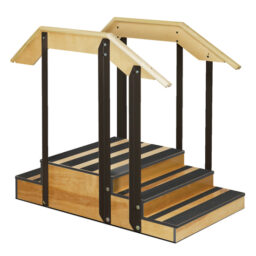
Small Straight Up & Down Staircase 30in/36in W
Item# X0055-4CLT $871.43 – $1,014.29Price range: $871.43 through $1,014.29


Choosing Between Models?
The Physical Therapy Equipment Buying Guide walks through the decisions behind this purchase, with a comparison method, the mistakes that cause returns and a pre-order checklist.
How Do the Staircase Models in This Category Group by Rail Configuration?
Rail configuration is the first sort, because it decides which side of the patient a clinician can stand on and how much floor the unit takes. The catalog splits into three groups plus one item that is not a staircase at all.
- Convertible rail. The Convertible Rail Support System Staircase changes configuration, so one unit covers more of a caseload in a gym that has room for a single staircase.
- One sided rail. The One-Sided Rail Support Staircase System 30in/36in W and the Adjustable One-Sided Staircase 30in/36in W carry a rail on one side and leave the other open for the clinician.
- Compact fixed and adjustable. The Adjustable Small Staircase 30in/36in W and the Small Straight Up & Down Staircase 30in/36in W are the smaller footprint units, one with adjustment and one without.
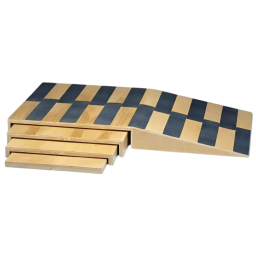
- Surface transition. The Curb & Ramp Training Set for Physical Therapy Rehab covers stepping and ramp work rather than a flight of steps.
Four of the six models are listed in both 30in and 36in widths, so width is a separate choice from rail configuration rather than a consequence of it.
What Does Adjustable Mean on a Training Staircase?
Adjustable means the unit can be set to more than one step configuration, which is why the Adjustable One-Sided Staircase 30in/36in W and the Adjustable Small Staircase 30in/36in W cost more than the fixed units beside them. What exactly adjusts, and through what range, is stated by the manufacturer for each model, so ask us for the specification sheet before assuming the two adjustable units work the same way.
The purchasing question is whether your caseload needs more than one setting. A clinic that sees one broad population and always rehearses the same domestic stair is served by a fixed unit such as the Small Straight Up & Down Staircase 30in/36in W. A department that works with a wide spread of ability, or that wants to grade the same task across a course of visits, gets more out of an adjustable model, because the alternative is buying and housing two staircases.
Adjustment also has an operational cost. Confirm how the adjustment is made, how long it takes, whether one person can do it between appointments and whether any tools are needed. An adjustment that takes two staff and a wrench will not happen on a busy schedule, and the unit will sit at whatever setting it was last left on.
How Much Floor Area and Clearance Does a Staircase Need?
Plan for the unit dimensions plus an approach at the bottom, a clear exit at the top and standing room for the clinician, which together are usually larger than the staircase itself. The specification sheet gives the unit footprint. The room has to give the rest.
- Approach. Leave clear floor at the foot of the stairs for a patient arriving with a walker, a cane or a wheelchair, and for the clinician to set up alongside.
- Exit. A staircase with a platform needs somewhere for the patient to stand and turn at the top. A straight up and down unit needs clearance at both ends.
- Working side. A one sided rail unit is bought partly for the open side. Do not put that open side against a wall.
- Width. A 36in unit takes more room than a 30in unit across the whole footprint, not only on the tread.
- Ceiling. Check the headroom above the top step for a standing adult, especially under ductwork or a dropped ceiling.
Measure the room and send us the dimensions before ordering. It is faster than returning a staircase that will not sit where you planned it.
Does the Curb and Ramp Training Set Replace a Staircase?
No. The Curb & Ramp Training Set for Physical Therapy Rehab covers a different task from a staircase, and clinics that do stair and community mobility work usually own both. A staircase rehearses a flight of steps with a rail. A curb and ramp set rehearses a single step up from a street, a sloped approach and the transitions a patient meets between a parking lot and a front door.
Buy the set as a complement rather than a substitute when your program discharges patients into environments with curbs, thresholds and ramps and you have already covered stairs. Buy the staircase first where the program’s stated goal is stairs at home. Where the budget covers only one item this cycle, ask which task appears more often on your therapists’ plans of care, and phase the second purchase into the next cycle.
Storage is a practical difference between the two. A staircase is a permanent block of floor. A curb and ramp set is a group of components, so confirm what the set contains, how the pieces are moved and where they will live between sessions, because loose pieces left across a gym floor become a hazard of their own.
What Should You Confirm on the Specification Sheet Before Ordering Training Stairs?
Confirm the stated weight capacity, the overall dimensions, the tread surface, the handrail height and diameter, the assembly required and the delivery access before the purchase order is issued. Training stairs are heavy, bulky and shipped as freight, so most of the problems on this item happen between the truck and the gym floor.
- Weight capacity. Take the figure from the manufacturer specification for the exact model and check it against the heaviest patient the gym expects.
- Tread surface. Confirm the stated surface and whether it can be replaced when it wears, since the tread is the part that sees every session.
- Handrails. Confirm rail height, diameter and whether rail height is adjustable on the model you are buying.
- Anchoring. Confirm whether the unit is free standing or intended to be fixed, and get landlord or facilities approval before ordering anything that has to be anchored in a leased suite.
- Freight access. Confirm crate dimensions, truck access, liftgate need and that every door, corner and elevator on the route clears the crate.
- Assembly and parts. Confirm what assembly is needed and which components, including treads and rail hardware, can be ordered separately later.
How Are Training Stairs Inspected and Kept Serviceable?
Fasteners, rail movement and tread condition are the three things to check on a schedule, because a staircase fails quietly. Nothing stops working. The unit simply loosens over months of loaded stepping until somebody notices a rail that moves under hand pressure.
Put the unit on the same inspection schedule as the rest of the gym equipment. Check every fastener at the rail posts and the frame, since these are the joints that take load in a direction the frame does not. Press the rails firmly at the top and midpoint and confirm there is no movement. Look at the tread surface for wear, lifting edges or loss of texture, particularly on the first and last steps, which take the most traffic. Check the feet, glides or casters and confirm the unit sits level with no rock.
Clean with an agent compatible with the manufacturer’s stated finish and with your infection control protocol. Keep the manufacturer’s manual with the unit, record the inspection, and ask us for the serviceable part numbers when a rail component or tread needs replacing rather than retiring an otherwise sound staircase.
When Does a Clinic Need Parallel Bars or a Rehab Work Table Instead?
When the task is level walking or seated table top work rather than stepping, a different item in the same line is the right purchase. Training stairs load one leg at a time through a step, which is a narrower task than it looks in a catalog.
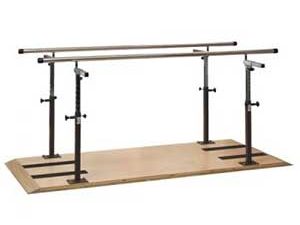
- Parallel Bars. Straight line standing and walking work with a handhold on both sides, specified by length, and generally the first large item a gait program buys.
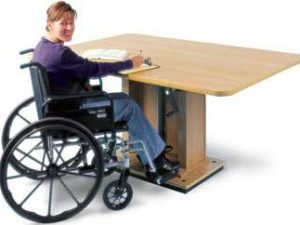
- Rehab Work Tables. A working surface for seated upper limb, fine motor and coordination tasks, with the clinician standing at a cutout.
Most therapy gyms end up with a staircase and parallel bars rather than one or the other, and the usual question is which comes first and which floor each one takes. The physical therapy equipment buyer guide works that sequence through from an empty room, the Physical Therapy Equipment page compares the three item types, and the wider rehabilitation equipment line covers the cardio, mat table and modality equipment that shares the same gym. Send us the room dimensions and your therapists’ priorities and we will price the sequence.
Frequently Asked Questions
How many steps should clinic training stairs have?
Step count is stated by the manufacturer for each model rather than chosen by the buyer, so compare the specification sheets for the units you are considering. The useful question is what your therapists rehearse most: a short flight with a platform suits programs working toward domestic stairs, while a straight up and down unit such as the Small Straight Up & Down Staircase 30in/36in W covers repetition practice in less floor space.
Can training stairs be moved between treatment rooms?
Some units are free standing and some are intended to be fixed in place, and the weight makes moving any of them a planned job rather than a daily one. Confirm on the manufacturer specification whether the model has glides or casters and what its assembled weight is. If the staircase has to serve two rooms, that is a strong argument for a smaller footprint unit sited where both programs can reach it.
Do training stairs have to be bolted to the floor?
That depends on the model, and the manufacturer specification states it. Where a unit is intended to be anchored, get facilities or landlord approval before you order, because an anchoring requirement discovered after delivery stalls the installation. In a leased suite or a multipurpose room, confirm the requirement first and consider a free standing configuration if anchoring is not going to be approved.
Can the handrail height be changed on a training staircase?
Rail height adjustment is a model specific feature, so confirm it on the specification sheet rather than assuming it from the word adjustable in a product name, which on these units generally refers to the step configuration. If a fixed rail height will not suit your population, tell us the height you need and we will check which of the six models in this category can be supplied that way.
What is the lead time on a staircase, and how does it ship?
These ship as freight, and lead time varies by model and current stock, so ask before you commit to an opening date. Confirm crate dimensions against every doorway, corner and elevator on the delivery route, decide who will receive and uncrate the unit, and ask whether a liftgate is needed. Call 877-706-4480 toll free and we will confirm current availability for the model you want.
Can you supply a staircase configuration that is not listed here?
Often, yes. Send the configuration you need, including rail arrangement, width, step count, platform requirement and weight capacity, to inquiry@msecompany.net or call 877-706-4480 toll free. We will tell you what is available and whether one of the six units already in this category meets the requirement at a lower cost and a shorter lead time.
Related Categories
Move up to Physical Therapy Equipment, or across to the lines ordered alongside this one.
GSA contract holder • Ships nationwide • From Patient to Doctor & Everyone In Between
Talk to a Medical Equipment Specialist
Toll free 877-706-4480 | Local 713-706-4480 | inquiry@msecompany.net