

Therapeutic Ultrasound Machines
Ultrasound and combination therapy chassis for rehabilitation departments, compared by supplied applicators, ports and panel configuration, with the specification checks to make before ordering.
Home › Rehabilitation Equipment › Therapeutic Devices › Therapeutic Ultrasound Machines
Therapeutic Ultrasound Machines for Physical Therapy Departments
A therapeutic ultrasound machine is the generator unit that produces the output an applicator delivers, and it holds the controls a clinician sets before a session, including timer, frequency and duty cycle. The applicator, or sound head, is a separate part that plugs into it. Physical therapy and occupational therapy departments, hospital rehab units and athletic training rooms specify these units by chassis, and the clinician decides the modality, the placement and every setting on the panel.
Shop Therapeutic Ultrasound Machines
Everything MSEC carries in Therapeutic Ultrasound Machines, shown in full. Specifications are supplied by the manufacturer. For current pricing, lead time or a quote on a purchase order, call toll free 877-706-4480.
-
 Quick ViewSelect options
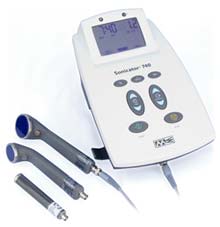
Therapeutic Ultrasound w/ 3 Applicators
Item# X047MET$2,600.29Original price was: $2,600.29.$2,177.89Current price is: $2,177.89. -
 Quick ViewSelect options
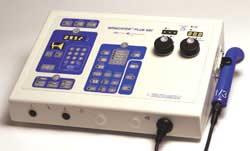
Sonicator Plus 992 Combination Ultrasound Therapy
Item# 299EMMET$5,573.57Original price was: $5,573.57.$4,128.57Current price is: $4,128.57. -
 Quick ViewSelect options
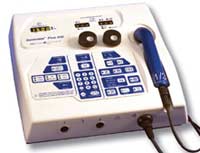
Sonicator Plus 930 Combination Therapy Unit
Item# 039EMMET$4,219.71Original price was: $4,219.71.$3,125.71Current price is: $3,125.71. -
 Quick ViewSelect options
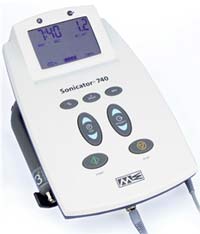
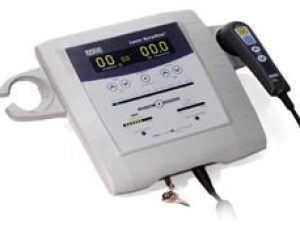
Sonicator 740 Therapeutic Ultrasound
Item# 047EMMET$2,068.39Original price was: $2,068.39.$1,532.14Current price is: $1,532.14.


Choosing Between Models?
The Therapeutic Devices Buying Guide walks through the decisions behind this purchase, with a comparison method, the mistakes that cause returns and a pre-order checklist.
What Does a Therapeutic Ultrasound Machine Actually Consist Of?
It consists of a chassis, a control panel, one or more applicator ports and the cabled applicator that plugs into them. The chassis is what you are buying on this page. The applicator is a matched part with its own frequency or effective surface area, and it is ordered against the host unit rather than against the model family.
On the panel you will find the controls that define a session: a timer, the frequency selection the unit supports, duty cycle selection, an intensity control and a display. A combination chassis adds the sections for its other modality alongside these. Behind the panel, the parts that matter to a buyer are the port or ports, the mains cord, the housing material and whether the unit is intended to sit on a bench or mount on a cart.
Everything in that list is a specification question, answered from the manufacturer documentation for the exact model and serial range. Nothing on this page speaks to what a modality is selected for, which is the treating clinician’s decision.
Which Therapeutic Ultrasound Machines Are Listed in This Category?
Four listings sit in this category, and the names themselves state the difference: one ultrasound only chassis, two combination chassis and one configuration named for the number of applicators it is supplied with.
| Listing | What the listing name states | Where it fits a department |
|---|---|---|
| Sonicator 740 Therapeutic Ultrasound | Ultrasound only chassis, model 740 | A bay that needs ultrasound capability on its own, with stimulation handled by a separate unit |
| Sonicator Plus 930 Combination Therapy Unit | Combination chassis, model 930 | One housing covering more than one modality where bay count is tight |
| Sonicator Plus 992 Combination Ultrasound Therapy | Combination chassis, model 992, named for ultrasound therapy | The other combination chassis in the line, compared to the 930 on its panel and port layout |
| Therapeutic Ultrasound w/ 3 Applicators | Supplied with three applicators | A department that moves between treatment sites without swapping hardware mid session |
The table states only what the listing names state. Port counts, panel layout, dimensions, weight and electrical requirements are confirmed against the manufacturer specification for the exact model before ordering. If the configuration you need is not one of these four, send us the requirement and we will confirm what is available.
What Is on the Panel of a Combination Chassis That an Ultrasound Only Unit Does Not Have?
A separate set of output controls, and the ports that go with them. That is the concrete difference on the specification sheet between the Sonicator Plus 930 Combination Therapy Unit or the Sonicator Plus 992 Combination Ultrasound Therapy and the Sonicator 740 Therapeutic Ultrasound, and it is what a buyer compares line by line rather than by the word combination in the title.
- Output sections. Confirm which modalities the chassis carries and how the panel separates them.
- Channel count. Where the chassis carries stimulation capability, confirm how many channels it supports, because that is what decides how many setups one unit covers at once.
- Connectors. A combination chassis has more than one connector family on it. Confirm each one against the leads and applicators you already own.
- Footprint and weight. More capability in one housing usually means a larger chassis, which changes bench space and cart choice.
Whether a combination chassis or two separate units suits your schedule is a different question, and the therapeutic devices buyer guide works through it against bay count and service risk.
How Many Applicators Does a Machine Come With?
Only one listing here states a count. The Therapeutic Ultrasound w/ 3 Applicators configuration is supplied with three, and the remaining listings do not state a number in the name, so confirm the supplied configuration on the specification before ordering.
That matters for two reasons. An applicator is tied to a host unit and to a frequency or effective surface area, so the heads that come in the box define what the unit can cover without a further order. And a department that moves between treatment sites in a session saves the swap time when the right head is already connected or on the cart.
Applicators, spare sound heads and the carry items that go with portable units are listed one page across in Therapeutic Ultrasound Applicators and Accessories. Order a spare head for the frequency your department uses most at the same time as the chassis, so a damaged applicator cable does not take the unit out of service for a lead time nobody planned for.
What Should a Department Confirm on the Specification Sheet Before Ordering?
Confirm the electrical supply, the applicator ports, what is in the box and how the unit will be serviced, in that order. Those four answers prevent almost every problem that appears after delivery.
- Electrical supply. Confirm voltage and cord configuration against the outlet in the bay, and check the cord reaches without an extension.
- Ports and connectors. Confirm the port type and count, then check them against every applicator and lead you intend to reuse.
- Box contents. Confirm which applicators, cables, gel and manuals are supplied, and whether a cart is included or ordered separately.
- Bench or cart. Confirm the footprint and plan the bay around it, including where the applicator cable will hang between sessions.
- Cleaning protocol compatibility. Confirm which agents the manufacturer permits on the housing, the panel and the applicator face before you standardize on a disinfectant.
- Serviceable parts and service route. Confirm which parts are replaceable and where a unit goes for service, since that decides how long a fault keeps a modality off the floor.
- Availability, lead time and warranty terms. Ask for all three on the quote, in writing, for the exact model.
What Fails First on a Therapeutic Ultrasound Machine?
The applicator cable, well before the chassis. It is handled every session, coiled, stretched toward the plinth and flexed hardest at the point where it enters the plug and the head, so that is where an inspection starts.
- Applicator cable and strain relief. Look for stiffness, kinks, cracked insulation and any output that changes when the cable is moved.
- Applicator face. Check for scoring, pitting and residue, and clean it only with agents the manufacturer permits.
- Mains cord and plug. Inspect where the cord leaves the chassis and where it is walked over by cart casters.
- Panel controls. Note any control that has become intermittent or a display segment that has dropped, because those are service items rather than user repairs.
Keep the model and serial number from the plate in the equipment log with the part numbers for the applicators the unit uses. When a fault appears, that record turns a diagnostic conversation into a parts order. A spare applicator on the shelf is the single cheapest piece of downtime insurance in this category.
When Does a Buyer on This Page Need a Different Category Instead?
When you are replacing a part rather than the chassis, or when the department actually needs a different modality. Five neighboring pages cover those cases.
- Sound heads and carry items: Therapeutic Ultrasound Applicators and Accessories, matched to a host unit by frequency or effective surface area.
- Stimulation chassis: Neuromuscular Stimulators for clinic NMES units, and TENS Units where a transcutaneous electrical nerve stimulation unit is issued for a home program on clinician instruction.
- Shortwave equipment: Diathermy Units and Accessories, which takes more floor space than a tabletop unit.
- Consumables: Electrodes and Lead Wires and Electrotherapy Accessories for the pads, cables and cases that are consumed on a combination chassis.
For how the modality line fits together, see Therapeutic Devices, and for the selection process start at the buyer guide. The full catalog around it sits under Rehabilitation Equipment and Products, which is worth reviewing when a bay is being equipped rather than a single unit replaced.
Frequently Asked Questions
What comes in the box with the machine?
Confirm it on the specification for the exact model, because supplied configurations differ. Only the Therapeutic Ultrasound w/ 3 Applicators listing states an applicator count in its name. Ask specifically about applicators, cables, gel, manuals and whether a cart is included or ordered separately, and get the answer on the quote so there is no assumption to argue about after delivery.
What is the difference between the Sonicator Plus 930 and the Sonicator Plus 992?
Both are combination chassis in this category, and the differences that matter to a buyer are on the specification sheet rather than in the names: output sections, channel count, connector families, panel layout, footprint and weight. Send us both model numbers and the leads and applicators you already own, and we will set the current manufacturer specifications side by side before you commit to either.
Can we use our existing applicators with a new machine?
Only where the manufacturer specifies them for that chassis. Record the model and serial number from the plate of the new unit and the part numbers of the heads you hold, and we will confirm compatibility rather than matching on connector shape. Frequency and effective surface area are stated per applicator, so a head that plugs in is not automatically the head the department needs.
How long do these units take to arrive?
Ask for availability and lead time on the quote, for the exact model and configuration, since chassis and applicators are not always shelf stock and the two can move at different rates. If a unit is replacing one already on the floor, plan the changeover around that lead time rather than around the purchase order date, and keep the old unit in service until the new one is delivered and checked.
Should a department standardize on one model across all its bays?
Standardizing reduces the number of applicator part numbers, cables and spares you carry, and it shortens staff training when clinicians move between rooms. The trade is that a single fault pattern can affect every unit at once. Where a department runs several bays, many buyers standardize the chassis and hold shared spares, then confirm that the spares fit every serial range they own.
What should we have ready when we call about a unit?
Have the model and serial number from the unit plate, the applicators and cables you currently hold, the outlet configuration in the bay, and whether the unit sits on a bench or a cart. That lets us confirm the specification, the compatible parts, availability and lead time in one conversation. Call 877-706-4480 toll free or 713-706-4480 local, or email inquiry@msecompany.net.
Related Categories
Move up to Therapeutic Devices, or across to the lines ordered alongside this one.
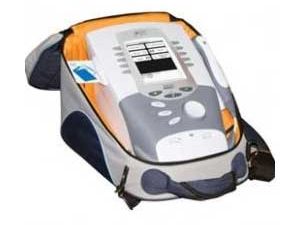
Therapeutic Devices
The full Therapeutic Devices line.

GSA contract holder • Ships nationwide • From Patient to Doctor & Everyone In Between
Talk to a Medical Equipment Specialist
Toll free 877-706-4480 | Local 713-706-4480 | inquiry@msecompany.net